When Multimodal Signals Become Context
Combining signals does not automatically create better understanding. The value of multimodal neuroscience comes from preserving timing, quality, and the distinct meaning of each stream before drawing a conclusion.
More signals are not automatically more insight
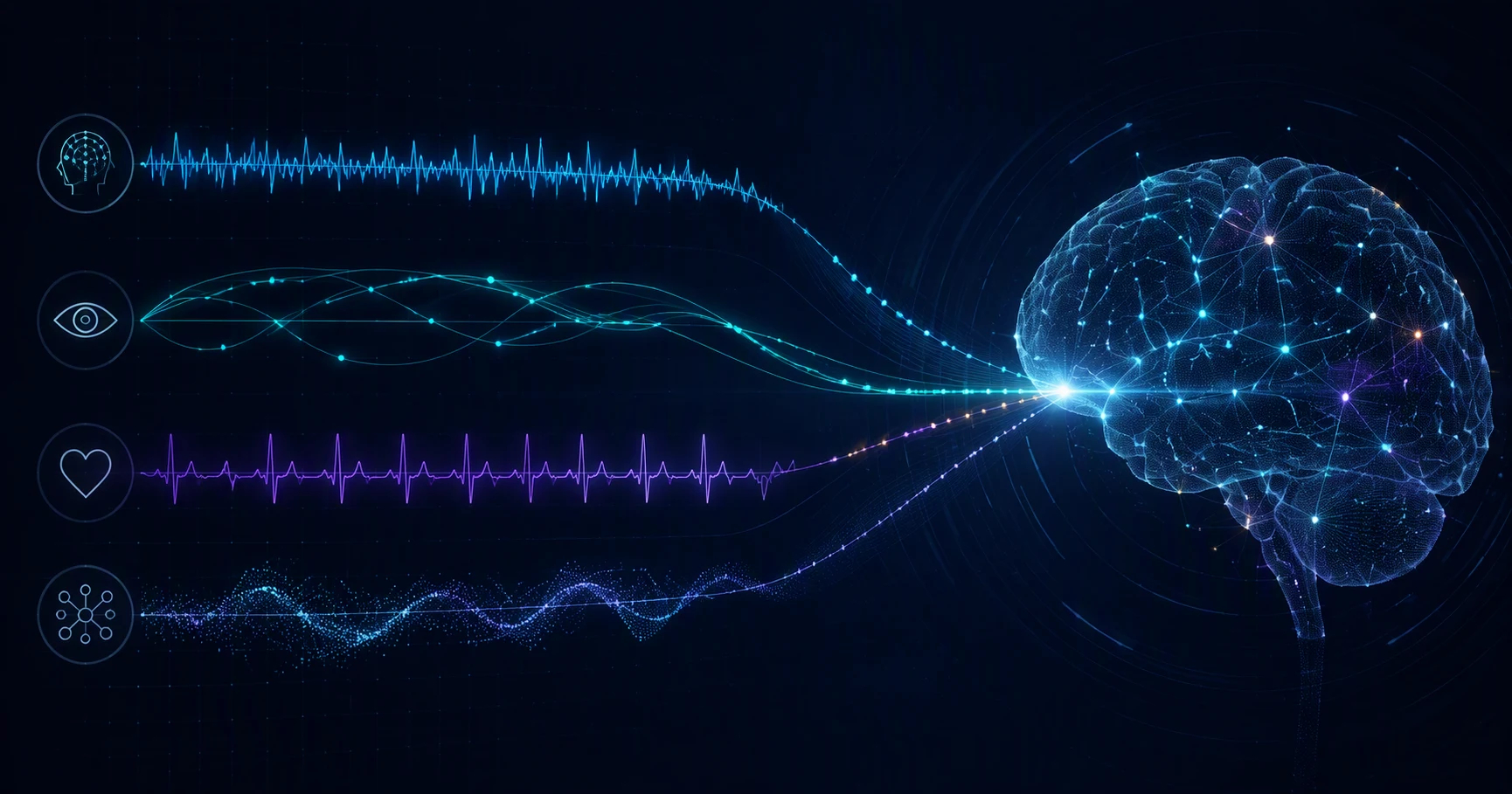
Multimodal analysis is attractive because human behavior is expressed across systems. Attention can change eye movements, muscle tone, heart rhythm, and neural activity at the same time. Looking at those streams together can reveal relationships that one sensor would miss. But adding channels also adds clocks, artifacts, missing data, and opportunities for false alignment.
The first design decision is therefore semantic: what question is each stream helping answer? EEG may describe a temporal pattern of neural activity, eye movement may describe visual exploration, and cardiac or motion signals may provide physiological or behavioral context. They are complementary, not interchangeable.
A system becomes more interpretable when each signal keeps its own identity until the point where a clearly defined analysis needs them combined. Early fusion is convenient, but it can hide which stream actually drove a result.
- Define the role of every stream before selecting a fusion strategy.
- Keep raw, derived, and quality metadata distinguishable.
- Make the evidence for a cross-signal conclusion inspectable.
A shared timeline is the foundation
A relationship between two signals is meaningful only when their timing is trustworthy. Device clocks drift, packets arrive late, sampling rates differ, and event markers may be recorded by a separate computer. Arrival order is not the same thing as event time.
A robust pipeline stores source timestamps, acquisition metadata, and the estimated relationship between clocks. It also preserves uncertainty. If a synchronization marker is approximate, that approximation should travel with the derived feature rather than disappearing into a preprocessing step.
The canonical analysis window should have an explicit state: complete, provisional, or missing. This gives downstream models and users a meaningful way to handle late packets and gaps instead of treating every window as equally reliable.
| Signal | Useful context | Common risk |
|---|---|---|
| EEG | Temporal neural activity | Reference, electrode, and movement artifacts |
| Eye movement | Visual exploration and gaze behavior | Blinking, calibration drift, occlusion |
| Cardiac | Autonomic and physiological context | Motion contamination and sensor placement |
| Motion | Task execution and artifact explanation | Unmodeled movement or missing landmarks |
Quality flags protect the interpretation
A clean-looking chart can still represent an unreliable window. Filtering, interpolation, artifact rejection, and resampling all change the relationship between the recorded signal and the displayed feature. Multimodal systems should expose those transformations as provenance, not treat them as invisible implementation detail.
Quality flags are especially valuable when one stream is usable and another is not. The system may still produce a partial result, but it should say which evidence is present and which is absent. A model can then learn to handle missingness explicitly, while a human can avoid over-reading a confident-looking summary.
This is also where cross-signal context becomes protective. Motion can explain a transient EEG change; a blink can explain an eye-tracking gap; a missing cardiac segment can make a timing claim uncertain. The goal is not to remove every artifact, but to preserve enough information to reason about it.
Fusion should follow the question
There is no universally correct fusion architecture. Early fusion can help when synchronized low-level features are stable and the dataset is large enough to support the joint representation. Late fusion can be easier to audit because each modality produces an intermediate result before a final layer combines them. Hybrid approaches are useful when some relationships are local and others are contextual.
The choice should follow the question, the data quality, and the cost of being wrong. In a research workflow, preserving separate modality outputs may be more valuable than a small increase in benchmark accuracy. In a live interface, a simpler model with clear missing-data behavior may create more trust than a complex model that cannot explain its inputs.
Multimodal intelligence works best when it produces a coherent story without erasing the evidence underneath. Synchronize carefully, label uncertainty, and let each stream contribute the kind of context it can actually support.
Frequently asked questions
What makes a multimodal result trustworthy?
Reliable timing, explicit signal roles, quality metadata, versioned preprocessing, and a clear explanation of how the streams were combined.
Should all signals be fused at the raw-data level?
Not necessarily. Early, late, and hybrid fusion each have trade-offs; the right choice depends on the question, data quality, and required auditability.
How should missing streams be handled?
Represent missingness explicitly, preserve the quality state, and ensure models and interfaces do not present partial evidence as a complete observation.
Why keep motion data in a neuroscience pipeline?
Motion can describe task behavior and explain artifacts in other streams, making it useful context rather than merely unwanted noise.
Sources and further reading
Make your next data workflow easier to trust.
Explore the platform for connected AI, biosignal processing, and modular team workflows.