Designing Lower-Latency Pipelines for Multi-Signal Analysis
Real-time multimodal analysis fails when streams are individually fast but collectively out of time. This guide explains the pipeline decisions that make synchronized EEG, ECG, and EMG workflows usable.
Latency is a pipeline property, not a single number
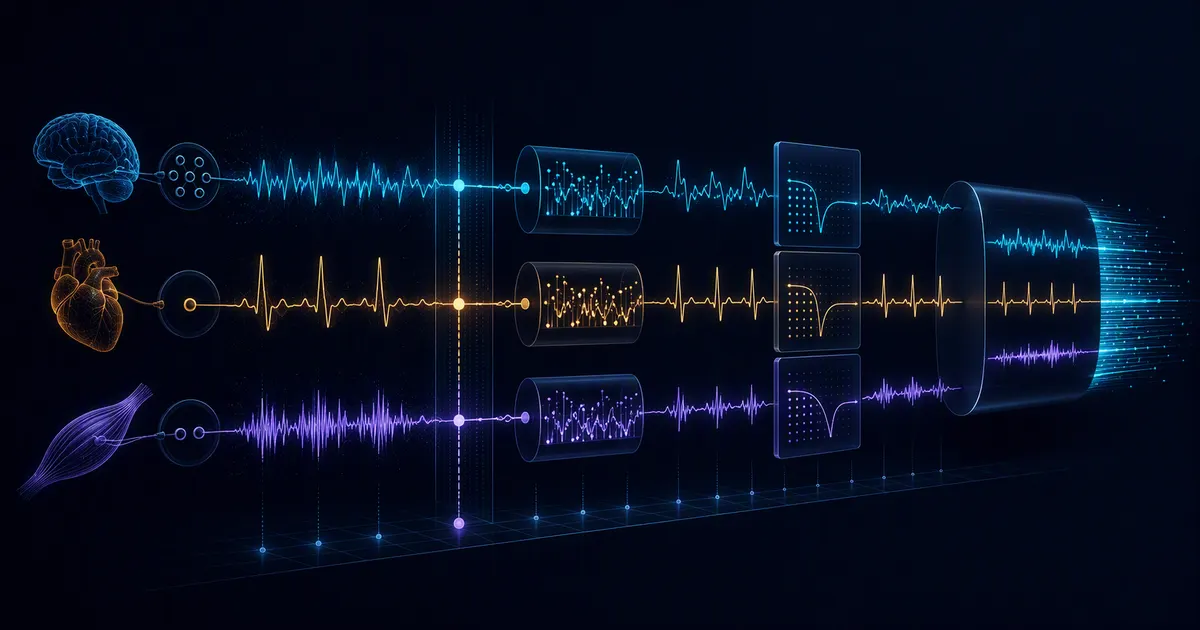
A multimodal biosignal product can report a fast model inference time and still feel slow or misleading to a user. The real experience includes acquisition, transport, buffering, timestamp alignment, filtering, feature extraction, inference, serialization, and rendering. If one stream waits for a late packet while another advances, the system may be technically active but semantically behind.
The first step is to define the product’s latency budget from the user action backward. A live feedback loop, a monitoring view, and an offline research export do not need the same target. Each should specify the maximum acceptable age of the data, how much reordering is tolerated, and what the UI should show when a stream is late.
SyncNeurons uses the idea of a pipeline contract: every stage declares its input clock, output clock, window size, expected delay, and failure behavior. This makes latency visible before it becomes a debugging session.
| Stage | Typical responsibility | What to measure |
|---|---|---|
| Acquisition | Capture samples and device timestamps | Sample gaps, clock drift |
| Transport | Move packets to the processing boundary | Network delay, jitter, loss |
| Alignment | Place streams on a shared timeline | Offset, skew, late packets |
| Processing | Filter, extract features, infer | Queue age, compute time |
| Presentation | Render state and status | Data age, frame delay |
Timestamp alignment comes before clever inference
EEG, ECG, and EMG devices may use different clocks, sample rates, packet sizes, and transport paths. Arrival time is therefore a poor substitute for event time. A robust pipeline preserves the source timestamp, records the clock or device identifier, and estimates the relationship between clocks over the session.
Alignment can use a shared hardware trigger, a synchronized host clock, periodic markers, or a software calibration phase. The choice depends on the hardware and the required precision. Whatever mechanism is used, the resulting offset and uncertainty should remain observable rather than disappearing inside a preprocessing function.
A useful windowing strategy is to define a canonical analysis interval and ask each stream for the samples that belong to that interval. If a packet arrives late, the system can mark the window as provisional, wait within a bounded grace period, or emit a gap status. Silent interpolation is dangerous when users interpret the result as a measured event.
- Keep event time and arrival time as separate fields.
- Store clock offset and drift estimates with the session metadata.
- Make provisional, complete, and missing window states explicit.
- Use deterministic window IDs so reprocessing does not duplicate results.
Buffering is a controlled trade-off
A buffer absorbs jitter and lets the aligner wait for late packets. A larger buffer improves completeness but increases age; a smaller buffer reduces delay but increases gaps. The correct size comes from observed transport behavior and the product’s latency budget, not from a universal constant.
Ring buffers are a good fit for live analysis because they bound memory and make the active time window explicit. They should be paired with backpressure. When the downstream processor falls behind, the system needs a declared policy: drop old intermediate frames, lower preview resolution, queue for later, or pause a non-critical feature. Unbounded queues only hide the problem until memory or user trust fails.
A useful status surface shows data age, not just connection status. “Connected” can be true while the visible waveform is several seconds old. Showing last complete window, current buffer depth, and dropped packet count gives operators a path to diagnose the difference.
Filtering and artifact handling need provenance
Filtering changes a signal. High-pass, low-pass, notch, resampling, and artifact rejection each affect what a downstream model can infer. A production pipeline should record the filter family, parameters, sampling assumptions, and preprocessing version with the derived output. That metadata is part of the result’s meaning.
Artifact handling should also be explicit. Motion, electrode impedance changes, electrical noise, and packet loss can make a window unreliable. Instead of turning every bad segment into a plausible-looking value, attach quality flags and let the product decide whether to suppress, annotate, or request another sample.
This is where multimodal context helps. A motion artifact in EMG may explain a change in an EEG feature; a missing ECG segment may make a timing relationship uncertain. The pipeline should preserve those relationships so the user can distinguish a physiological event from a data-quality event.
- Emit signal-quality scores alongside features.
- Propagate artifact flags into dashboards, exports, and model inputs.
- Version preprocessing code and configuration together.
- Never present imputed or provisional values as indistinguishable from measured data.
Observability closes the real-time loop
A real-time pipeline needs traces that follow one window across every stage. Use a session ID, window ID, and source stream IDs to connect acquisition logs, alignment events, feature jobs, inference results, and UI updates. The trace should make it possible to answer whether a slow result came from transport, waiting for alignment, filtering, inference, or rendering.
Latency should be reported as distributions rather than only averages. Track p50 for normal experience, p95 for capacity planning, and a clear maximum or timeout for the user contract. Also track completeness, late-window rate, artifact rate, and the age of the newest complete result.
The end state is a system that can be fast and honest. When a window is incomplete, the UI should say so. When a pipeline is catching up, the operator should see it. When an analysis is reprocessed, the result should carry its version and provenance. That clarity is more valuable than claiming an impressive but incomplete real-time number.
Frequently asked questions
Why can a fast model still produce a slow biosignal experience?
End-to-end latency also includes acquisition, transport, buffering, timestamp alignment, preprocessing, serialization, and rendering.
Should EEG, ECG, and EMG use arrival time for synchronization?
No. Preserve source event timestamps and model clock offset, drift, network delay, and late-packet behavior explicitly.
What does a real-time buffer control?
It absorbs transport jitter and gives late packets time to arrive, trading lower data age against fewer incomplete windows.
How should artifact handling appear to users?
Expose quality scores and artifact flags so users can distinguish an uncertain or imputed window from a clean measured result.
What is a useful latency budget?
It depends on the workflow. Define a maximum age for the user experience, then measure every stage against that budget instead of optimizing inference alone.
Sources and further reading
Make your next data workflow easier to trust.
Explore the platform for connected AI, biosignal processing, and modular team workflows.