The SaaS Operating System for Signal-Rich Products
Signal-rich products need more than a dashboard and a data lake. They need an operating model for time, quality, permissions, model behavior, and the people who act on the result.
Signal-rich SaaS is an operating system for decisions
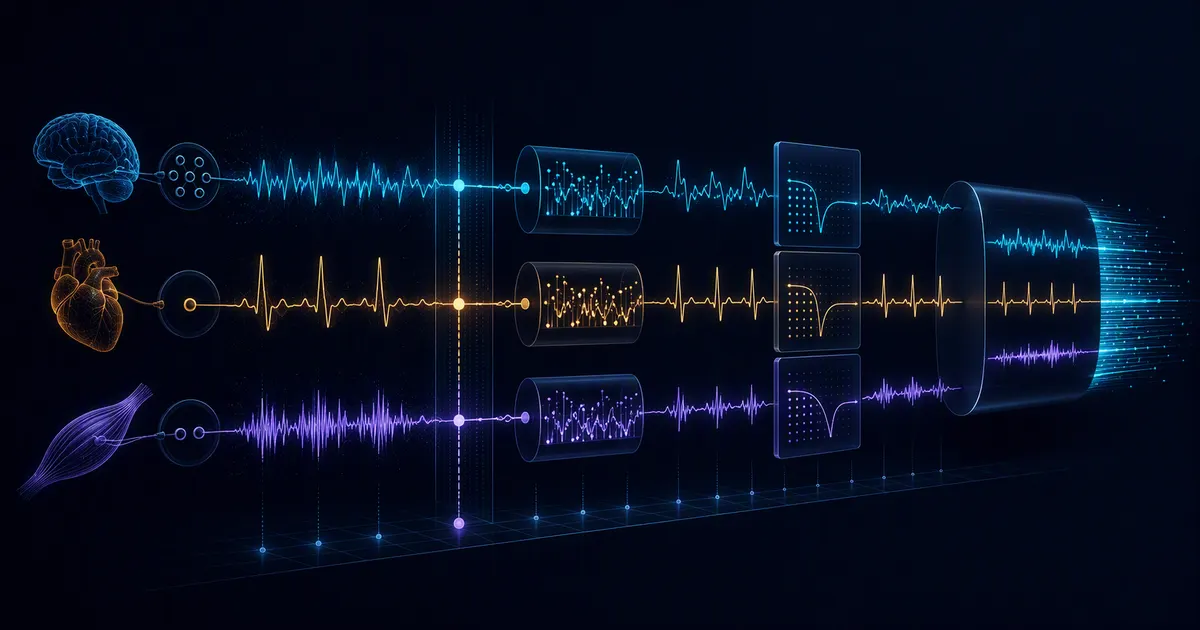
A conventional SaaS product organizes records, permissions, and workflows. A signal-rich product must also receive time-dependent streams, turn them into windows and features, evaluate quality, and help a person or another system decide what to do next.
That makes the platform more than a collection of screens. It is an operating system for evidence: preserve meaning across time, make transformations traceable, isolate data safely, and deliver the right context to the next decision.
EEG, ECG, EMG, motion, behavioral events, and operational telemetry can all fit this model. The domain changes, but the product architecture still needs the same contracts.
- Ingest signals with source time, quality, and acquisition context.
- Separate raw data, derived features, interpretations, and actions.
- Make automated conclusions explainable enough for their intended user.
The five contracts every signal-rich product needs
Reliable platforms make assumptions explicit. A signal contract defines what was measured and how it is timestamped. A quality contract describes whether a window is complete, noisy, delayed, or missing. A feature contract names the transformation and version that produced a derived value.
The platform also needs an access contract and a decision contract. The first defines who may see which data for which purpose. The second explains how a feature or model output becomes a recommendation, alert, or workflow action.
These contracts reduce ambiguity between devices, pipelines, models, and interfaces, and make it easier to introduce a new model or sensor without silently changing the meaning of existing data.
| Contract | It answers | Failure when absent |
|---|---|---|
| Signal | What was measured and when? | False alignment and irreproducible analysis |
| Quality | Can this window be trusted? | Partial data presented as complete |
| Feature | How was this value produced? | Unclear model behavior and drift |
| Access | Who can use it and why? | Overexposure and weak tenant isolation |
| Decision | What should happen next? | Scores without an operational path |
Time and quality are first-class product primitives
In a signal-rich workflow, arrival time is not event time. Devices drift, packets arrive late, and streams use different sampling rates. Preserve source timestamps, synchronization markers, window boundaries, and the uncertainty of any alignment step.
Quality should travel with the data. A downstream model needs to know whether a window is complete, provisional, or missing; a human needs to know whether an alert is based on a clean segment or a heavily processed one.
The interface can keep this compact. A simple ‘complete’, ‘limited’, or ‘needs review’ state is often enough at the surface, as long as the deeper view can explain what caused it.
Where neural networks belong in the stack
Neural networks are valuable when the signal-to-decision path contains patterns that are difficult to express with fixed rules. They can classify windows, estimate states, detect anomalies, or combine modalities. But the model is one layer in the operating system, not the operating system itself.
Production use requires versioned inputs, stable preprocessing, representative evaluation sets, and a clear response to missing or unfamiliar data. Record which model and feature versions produced an output and whether it passed quality and policy checks.
This separation keeps model progress from destabilizing the product. A better model can be evaluated and introduced behind the same signal, quality, access, and decision contracts.
- Keep preprocessing and feature definitions versioned alongside the model.
- Evaluate ordinary, ambiguous, missing-data, and unfamiliar cases.
- Expose confidence as context, not as a substitute for evidence.
- Provide human review for actions with material consequences.
Build for the full loop: capture, interpret, act, learn
The durable SaaS pattern is a closed but inspectable loop: capture the signal, align and qualify it, derive features, interpret the result, present an action, record what happened, and use corrections to improve the workflow.
For EEG and other biosignal applications, this loop also needs strong boundaries around identity, tenant data, and raw waveforms. A product may allow a team to work with derived features while restricting direct identifiers or raw signal export to a smaller set of roles.
The winning platform is not the one with the most algorithms. It is the one that turns complex streams into repeatable decisions while keeping timing, quality, security, and accountability visible.
Frequently asked questions
What makes a product signal-rich?
It depends on time-dependent streams or high-volume measurements whose meaning depends on alignment, quality, transformation, and context.
Is a signal-rich SaaS product just a dashboard?
No. It also needs contracts for time, quality, features, access, model behavior, and the actions that follow an interpretation.
Where do neural networks fit?
They provide one interpretation layer inside a broader system that still needs versioned preprocessing, evaluation, observability, permissions, and human escalation.
How should SaaS handle real-time signal latency?
Define latency budgets per stage, distinguish event time from arrival time, and make provisional or delayed windows visible instead of silently presenting stale results.
Sources and further reading
Make your next data workflow easier to trust.
Explore the platform for connected AI, biosignal processing, and modular team workflows.